3. Capital and financial risk management
This section outlines the principles and procedures applied to manage the capital structure and the financial risks to which the Group is exposed. Detailed information on dormakaba Group’s sources of funding, such as credit facilities and bonds, are also provided here. In addition, the details of the share capital, treasury shares, earnings per share, and dividends are disclosed in this section.
3.1 Capital management
Capital management has the following objectives:
- securing sufficient liquidity to meet the Group’s needs to fulfil its financial obligations;
- securing sufficient funding capacity for future investments and acquisitions;
- ensuring creditworthiness;
- achieving an appropriate risk-adjusted return for investors.
In response to ongoing economic and geopolitical uncertainties, including trade tariffs and geopolitical conflicts such as the wars in Ukraine and the Middle East, dormakaba continues to maintain a strong focus on liquidity and net working capital management. This includes stringent credit management, disciplined collection of trade receivables, and careful cash conversion to effectively mitigate risks. Daily monitoring of liquidity and financial debt status at Group level, including oversight of financial covenants and undrawn credit facilities, remains a key priority. Alongside these cash management efforts, dormakaba also conducts regular reviews of safety stocks to ensure supply capabilities amidst ongoing supply chain challenges, further reinforcing the companyʼs financial stability.
Borrowings and other financial liabilities
|
CHF million |
|
Financial year ended 30.06.2026 |
|
Financial year ended 30.06.2025 |
|
Current borrowings |
|
23.5 |
|
322.9 |
|
Short-term bank loans and overdrafts |
|
21.5 |
|
2.3 |
|
Bonds – short-term |
|
0.0 |
|
320.0 |
|
Current portion of other non-current liabilities |
|
2.0 |
|
0.6 |
|
Non-current liabilities |
|
483.7 |
|
480.4 |
|
Bonds – long-term |
|
474.3 |
|
474.0 |
|
Other non-interest bearing liabilities |
|
5.2 |
|
2.9 |
|
Other interest-bearing liabilities |
|
4.2 |
|
3.5 |
Credit facility
As of 30 June 2026, short-term bank loans and overdrafts amount to CHF 21.5 million (2024/25: CHF 2.3 million).
The syndicated credit facility of CHF 525 million will expire at its final maturity on 31 December 2027. The CHF 200 million increase option remains available. The facility’s sole financial covenant is the leverage ratio. It is calculated based on net debt relative to (reported) EBITDA for the past 12 months as of June and December. As of 30 June 2026 and throughout the 2025/26 financial year, dormakaba complied with the financial covenant.
Net debt
The key figures, including the maturities, as of 30 June 2026 and 30 June 2025 are disclosed below.
|
|
|
Financial year ended 30.06.2026 |
|
Financial year ended 30.06.2025 |
||||||||||||
|
CHF million |
|
Up to 1 year |
|
2 to 5 years |
|
Over 5 years |
|
Total |
|
Up to 1 year |
|
2 to 5 years |
|
Over 5 years |
|
Total |
|
Short-term bank loans and overdrafts |
|
21.5 |
|
|
|
|
|
21.5 |
|
2.3 |
|
|
|
|
|
2.3 |
|
Bonds |
|
|
|
474.3 |
|
|
|
474.3 |
|
320.0 |
|
474.0 |
|
|
|
794.0 |
|
Other liabilities |
|
2.0 |
|
6.9 |
|
2.5 |
|
11.4 |
|
0.6 |
|
4.0 |
|
2.4 |
|
7.0 |
|
Cash and cash equivalents |
|
–149.1 |
|
|
|
|
|
–149.1 |
|
–445.1 |
|
|
|
|
|
–445.1 |
|
Net debt |
|
–125.6 |
|
481.2 |
|
2.5 |
|
358.1 |
|
–122.2 |
|
478.0 |
|
2.4 |
|
358.2 |
|
Adjusted EBITDA |
|
|
|
|
|
|
|
449.0 |
|
|
|
|
|
|
|
445.0 |
|
Net debt/Adjusted EBITDA (Leverage) |
|
|
|
|
|
|
|
0.8x |
|
|
|
|
|
|
|
0.8x |
The interest expenses for short-term bank loans and overdrafts are recorded within other interest expenses. Interest expenses are disclosed in detail in the note on the financial result (1.5).
Bonds
dormakaba Finance AG issued bonds with a total nominal value of CHF 475 million:
|
CHF million |
|
Coupon % p.a. |
Financial year ended 30.06.2026 |
|
Coupon % p.a. |
Financial year ended 30.06.2025 |
|
Bonds (at fixed interest rates) |
|
|
474.3 |
|
|
794.0 |
|
CHF 320 million bond 2017–2025 Payment date: 13 October 2017 Issue price: 100.46% |
|
|
|
|
1.000 |
320.0 |
|
CHF 275 million bond 2022–2027 Payment date: 14 October 2022 Issue price: 100.00% |
|
3.750 |
274.8 |
|
3.750 |
274.7 |
|
CHF 200 million bond 2025–2030 Payment date: 18 June 2025 Issue price: 100.012% |
|
1.375 |
199.5 |
|
1.375 |
199.3 |
The interest expenses for the bonds amount to CHF 14.2 million in 2025/26 (2024/25: CHF 13.7 million). This is disclosed in the note on the financial result (1.5).
Credit rating
S&P Global Rating rated dormakaba on 16 February 2026 with a BBB credit rating with a stable outlook.
3.2 Share capital and treasury shares
Share capital
On 28 October 2025, the company implemented a 1-for-10 share split, increasing the number of registered shares from 4,200,026 to 42,000,260.
As of 30 June 2026, the share capital comprised 42,000,260 registered shares with a par value of CHF 0.01 each. The shares are listed on the SIX Swiss Exchange (DOKA/ISIN CH1486524122).
Conditional capital as of 30 June 2026 amounted to CHF 42,438.40.
The company has a capital range ranging from CHF 378,002.60 (lower limit) to CHF 462.002.60 (upper limit). The Board of Directors is authorized within the capital range to increase or reduce the share capital once or several times and in any amounts or to acquire or dispose of shares directly or indirectly, until 5 October 2028, or until an earlier expiry of the capital range. The capital increase or reduction may be effected by issuing up to 4,200,000 fully paid registered shares with a nominal value of CHF 0.01 each or by canceling up to 4,200,000 registered shares with a nominal value of CHF 0.01 each, as applicable, or by increasing or reducing the nominal value of the existing registered shares within the limits of the capital range or by simultaneous reduction and reincrease of the share capital. No shares were issued out of authorized capital in the 2025/26 financial year.
Treasury shares
Treasury shares are recorded as a negative balance within equity and are disclosed in the consolidated statement of changes in equity. These registered shares are predominantly intended for share-based compensation. Further information about the long-term incentive stock award plans are disclosed in the note on personnel expenses (1.3) and within the Compensation Report.
|
|
|
Financial year ended 30.06.2026 |
|
Financial year ended 30.06.2025 |
||||||||
|
Equity and treasury shares |
|
Number of shares |
|
Transaction (Ø) price in CHF per share |
|
Treasury shares in CHF million |
|
Number of shares |
|
Transaction (Ø) price in CHF per share |
|
Treasury shares in CHF million |
|
Treasury shares at the end of the period |
|
411,732 |
|
63.56 |
|
26.2 |
|
413,330 |
|
67.31 |
|
27.8 |
|
Purchases of treasury shares |
|
149,292 |
|
53.47 |
|
8.0 |
|
385,000 |
|
67.18 |
|
25.9 |
|
Shares awarded (share-based compensation) |
|
–150,890 |
|
63.84 |
|
–9.6 |
|
–61,940 |
|
60.26 |
|
–3.8 |
|
Treasury shares at the beginning of the period |
|
413,330 |
|
67.31 |
|
27.8 |
|
90,270 |
|
63.03 |
|
5.7 |
|
Number of shares |
|
Financial year ended 30.06.2026 |
|
Financial year ended 30.06.2025 |
|
Total shares allocated |
|
150,890 |
|
61,940 |
|
Performance shares (LTIP) |
|
127,247 |
|
43,860 |
|
Restricted shares (BoD Members) |
|
23,643 |
|
18,080 |
Further information on the long-term incentive stock award plans is included in the Compensation Report.
3.3 Earnings per share and dividends
Earnings per share
|
Number of shares, except where indicated |
|
Financial year ended 30.06.2026 |
|
Financial year ended 30.06.2025 1 |
|
Net profit attributable to the owners of the parent in CHF million |
|
97.0 |
|
97.9 |
|
For basic number of shares |
|
|
|
|
|
Number of shares outstanding at the end of the period |
|
41,588,528 |
|
41,586,930 |
|
Own shares (acquired)/reissued |
|
1,598 |
|
–323,060 |
|
Number of shares outstanding at the beginning of the period |
|
41,586,930 |
|
41,909,990 |
|
Weighted average number of shares outstanding (basic) |
|
41,664,014 |
|
41,832,140 |
|
Basic earnings per share in CHF |
|
2.33 |
|
2.34 |
|
For diluted number of shares |
|
|
|
|
|
Weighted average number of shares outstanding (basic) |
|
41,664,014 |
|
41,832,140 |
|
Eligible shares under stock award plans |
|
478,064 |
|
423,810 |
|
Weighted average number of shares outstanding (diluted) |
|
42,142,078 |
|
42,255,950 |
|
Diluted earnings per share in CHF |
|
2.30 |
|
2.32 |
1 The Annual General Meeting approved the 1-for-10 share split on 21 October 2025. To enable a fair comparison with the current year, prior-year values were adjusted accordingly.
The earnings per share is calculated based on the profit attributable to the owners of the parent only. Net profit attributable to minority interests is not taken into account. The minorities represent mainly the shareholders, who hold 47.5% of the shares of dormakaba Holding GmbH + Co. KGaA, a direct subsidiary of the Group parent, dormakaba Holding AG, which holds the remaining 52.5%. The legal subsidiaries are disclosed in the note on the legal structure of the dormakaba Group (5.4).
Dividends
|
CHF million, except where indicated |
|
CHF per share 1 |
|
Financial year ended 30.06.2026 2,3 |
|
CHF per share 6 |
|
Financial year ended 30.06.2025 4 |
|
CHF per share 6 |
|
Financial year ended 30.06.2024 5 |
|
Dividend for the financial year |
|
0.95 |
|
39.5 |
|
0.92 |
|
38.4 |
|
0.80 |
|
33.5 |
|
Net profit attributable to the owners of the parent |
|
|
|
97.0 |
|
|
|
97.9 |
|
|
|
65.6 |
|
Dividend payout ratio in % |
|
|
|
40.7 |
|
|
|
39.1 |
|
|
|
51.1 |
1 Proposal to the AGM; dividend will be paid from 26 October 2026.
2 The dividend for the financial year is calculated on the basis of the outstanding shares at the end of the financial year (estimated final dividend payable, subject to AGM approval and variations in the number of shares up to the recording date). This dividend was not recognized as a liability as at 30 June 2026 and will be recognized in subsequent consolidated financial statements.
3 The BoD decided for FY 2025/26 not to adjust the net profit attributable to owners of the parent company when determining the dividend proposal (excluding goodwill amortization would lead to a dividend payout ratio of 36.8%).
4 In line with the BoD’s decision to not adjust the net profit attributable to owners of the parent company when determining the dividend proposal (excluding goodwill amortization would lead to a dividend payout ratio of 34.4%).
5 In line with the BoD’s decision to exclude the goodwill amortization impact when determining the dividend proposal, the net profit attributable to owners of the parent company was adjusted by CHF 23.4 million (CHF 44.5 million goodwill amortization impact less minorities of 47.5%).
6 The Annual General Meeting approved the 1-for-10 share split on 21 October 2025. To enable a fair comparison with the current year, prior-year values were adjusted accordingly.
Dividends are distributed annually. The company' dividend policy is to maintain or increase the dividend per share each year, regardless of short-term fluctuations in earnings. The approach reflects the Groupʼs focus on delivering consistent shareholder returns while preserving the financial flexibility needed for long-term growth and value creation.
For the 2025/26 financial year the Board is proposing a dividend of CHF 0.95 per share to the AGM on 20 October 2026. The dividend distribution is proposed in the form of distribution from statutory retained earnings of the parent entity, dormakaba Holding AG. After approval of this proposal by the AGM, the dividend distribution will be paid out as from 26 October 2026 according to the instructions received: CHF 0.95 (2024/25: CHF 0.92) gross per listed registered share at CHF 0.01 par value.
3.4 Financial risk management
The tasks of the BoD include identifying risks, determining suitable measures, and implementing these measures or having them implemented. The BoD of dormakaba Holding AG conducted a regular Group-wide risk assessment in the year under review and determined the risks to be managed at particular management levels.
The global economic environment remained broadly stable during the 2025/26 financial year, despite continued geopolitical and macroeconomic uncertainties. Trade tariffs, the conflicts in Ukraine and the Middle East, and concerns regarding inflation and investment activity remained key external factors influencing market conditions. In response, the Group Management has continued its comprehensive response strategy, ensuring that relevant reporting is provided to the EC and BoD. The measures are designed to safeguard employees, minimize disruptions to business operations and supply chains, and ensure that the focus remains on strong cash conversion and capital management.
dormakaba has continued its robust financial management and forecasting practices to maintain entrepreneurial flexibility and financial stability. This includes daily monitoring of liquidity and financial debt status, encompassing financial covenants and undrawn credit facilities at Group level. Additionally, the solvency and credit spreads of all business banks are carefully evaluated, bank balances are managed within a risk budget, and excess cash is concentrated efficiently. Due to the further tightening of the sanction regime, dormakaba decided to discontinue its operational business activities in Russia. The Russian subsidiary stopped its trading and service activities and is converted into a representation office. The EC closely monitors the situation in the Middle East and has implemented measures to secure the employees and enhance supply chain resilience where required. This approach ensures that operating risks are effectively addressed, reported, and measures are adequately taken.
Liquidity risk
Liquidity risk arises due to the possibility that dormakaba Group might experience difficulty in settling its debts or otherwise meeting its obligations related to financial liabilities.
Liquidity risk is managed centrally by Group Treasury. Secured by solid free cash flow, the Group aims to balance funding continuity and flexibility, taking into consideration funding for the ongoing transformation and restructuring programs to ensure adequate liquidity for strategic initiatives. To avoid excessive refinancing in any single period, the Group maintains a diversified spread of maturities and ensures funding flexibility by securing a mix of uncommitted and committed credit lines with a range of counterparties and employing various financing instruments.
Credit risk
Credit risk is the risk of loss if a counterparty fails to fulfil its obligations to dormakaba Group. Hence, dormakaba Group is exposed to credit risk arising from financing activities, including deposits with banks and financial institutions, foreign exchange transactions, and other financial instruments such as trade receivables, other current assets, and non-current financial assets.
Cash and cash equivalents are mainly held in the form of current accounts, current fixed-term deposits or money market funds. Counterparty risks with financial institutions are monitored continuously and are minimized by the Group limiting its relationships to high-ranking banks only and limiting cash balances within a risk budget or level of national deposit protection schemes.
Trade receivables are monitored on an ongoing basis locally and via Group management reporting procedures. The danger of cluster risks with trade receivables is limited due to the large number and wide geographical spread of customers. The extent of the credit risk is determined mainly by the individual characteristics of each customer. The assessment of this risk involves a review of the customer’s creditworthiness based on its financial situation and experience. The maturity analysis of trade receivables is disclosed in the note on trade receivables (2.1).
Interest rate risk
Interest rate risk is the risk that the Group’s financial situation is impacted by changes in interest rates.
The Group is exposed to interest rate risk primarily through short-term borrowings and the future refinancing of maturing debt. Most long-term borrowings bear fixed interest rates until maturity, reducing the sensitivity of financing costs to short-term market fluctuations. Management strives for a well-balanced mix of long- and short-term interest rate exposure, taking into consideration the planned funding requirements and available free cash flow. Funding and related interest rate exposure are managed centrally by Group Treasury.
Foreign currency exposure
Translation risk
dormakaba Group does not actively manage the translation risk.
In the 2025/26 financial year, the Group’s equity was positively impacted in the amount of CHF 1.0 million by foreign currency translation (2024/25: CHF 44.6 million negative impact).
The key exchange rates based on net sales in foreign currencies are disclosed in the table below:
|
Currency rates (CHF), net sales (CHF million) |
|
Net sales 30.06.2026 |
|
Exchange rate 30.06.2026 |
|
Average rate 2025/26 |
|
Net sales 30.06.2025 |
|
Exchange rate 30.06.2025 |
|
Average rate 2024/25 |
|
|
Total net sales |
|
|
2,792.4 |
|
|
|
|
|
2,870.1 |
|
|
|
|
|
EUR |
b |
|
877.4 |
|
0.922 |
|
0.925 |
|
859.7 |
|
0.936 |
|
0.943 |
|
USD |
b8 |
|
732.2 |
|
0.807 |
|
0.793 |
|
763.4 |
|
0.800 |
|
0.867 |
|
CHF |
w |
|
231.9 |
|
1.000 |
|
1.000 |
|
220.1 |
|
1.000 |
|
1.000 |
|
AUD |
b6 |
|
193.9 |
|
0.556 |
|
0.538 |
|
197.7 |
|
0.522 |
|
0.562 |
|
CAD |
b4 |
|
162.6 |
|
0.568 |
|
0.574 |
|
187.0 |
|
0.584 |
|
0.622 |
|
GBP |
b2 |
|
91.7 |
|
1.071 |
|
1.065 |
|
107.5 |
|
1.096 |
|
1.122 |
|
INR |
db |
|
78.4 |
|
0.009 |
|
0.009 |
|
84.1 |
|
0.009 |
|
0.010 |
|
CNY |
g |
|
52.7 |
|
0.118 |
|
0.113 |
|
57.9 |
|
0.112 |
|
0.121 |
|
HKD |
g8 |
|
33.0 |
|
0.103 |
|
0.102 |
|
41.2 |
|
0.102 |
|
0.111 |
|
SEK |
g5 |
|
33.0 |
|
0.083 |
|
0.085 |
|
29.9 |
|
0.084 |
|
0.084 |
|
Net sales in other currencies |
g2 |
|
305.6 |
|
|
|
|
|
321.6 |
|
|
|
|
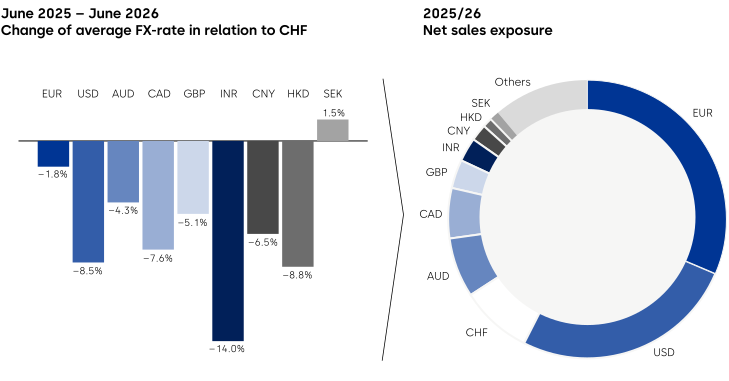
In the 2025/26 financial year, dormakaba Group’s sales growth was negatively impacted by foreign currency translations in the amount of CHF 141.7 million (2024/25: CHF 65.0 million negative impact) and its adjusted EBITDA negatively by CHF 24.8 million (2024/25: CHF 10.0 million negative impact).
Transaction risk
Management monitors foreign exchange risks on a regular basis. When management deems it appropriate to do so, dormakaba uses derivative financial instruments to manage its transaction risk exposure to fluctuations in exchange rates.
Foreign exchange risks relating to intercompany loans are covered fully by forward exchange contracts with third parties. The external counterparties involved are high-ranking financial institutions. dormakaba enters into financial transactions only to hedge against a related off-balance-sheet risk or a highly probable future business transaction. No uncovered short transactions are entered into.
Intercompany invoicing is structured in a way that foreign exchange risks within the dormakaba Group are concentrated in the manufacturing units or logistic hubs. The use of a group netting system with intercompany payment terms of up to 60 days reduces the intercompany exposure and foreign exchange risk. The third party and intercompany cross-currency exposures are reduced through natural hedges or using financial instruments.
dormakaba Group actively manages the transaction risk arising from third party and intercompany cross-currency exposures in foreign currencies.
The following currency forward contracts for hedging purposes existed as at the balance sheet date:
|
CHF million |
|
Financial year ended 30.06.2026 |
|
Financial year ended 30.06.2025 |
|
Contract value |
|
357.2 |
|
377.7 |
|
Fair value – held-for-trading, net |
|
1.1 |
|
4.0 |
|
Assets from fair value of forward contracts |
|
1.1 |
|
4.0 |
|
Liabilities from fair value of forward contracts |
|
0.0 |
|
0.0 |
In the 2025/26 financial year, the net foreign exchange loss amounted to CHF 2.8 million (2024/25: loss of CHF 6.9 million). Foreign currency effects arising from intercompany loans are hedged. Cash flows from intercompany hedging activities totaled CHF 2.0 million (2024/25: CHF 25.1 million) in the reporting year and are presented under cash flows from financing activities. The related interest costs of CHF 11.4 million (2024/25: CHF 14.0 million) are reported within net cash from operating activities.