Resource Use and Circular Economy
We are accelerating circular solutions to develop material- and energy-efficient, high-quality products that reduce our customers’ environmental impact and meet the needs of a sustainable built environment.
Our approach
We live in and depend on an interconnected world, with complex environmental, social, economic, and cultural systems. Damaging one element may have an unexpected impact elsewhere. We recognize the limits of our planet and that we must act more sustainably in order to meet increasing social and economic demands. As a leading manufacturer, dormakaba is committed to incorporating the latest product life cycle approaches and environmental technologies to continuously advance our product development and improve our own and our customers’ sustainability performance. This provides new opportunities for our design and manufacturing processes and addresses the demand for eco-friendly solutions.
Our Product Sustainability department, part of Global Innovations, oversees product sustainability globally, providing resources, and expertise, while shaping a state-of-the-art development environment. This also includes developing Environmental Product Declarations (EPD) and other sustainability-related product declarations and certifications, incorporating sustainability criteria into all product development-related processes, and developing guidelines.
Our global Environment Directive regulates environmental management in manufacturing practices as well as mandatory requirements on product circularity and eco-design, including energy efficiency and minimum recycled content benchmarks for each product family. The Environment Directive promotes the utilization of secondary materials and reused components in dormakaba products, while emphasizing design principles that ensure durability, recyclability, easy disassembly and adaptability. Additionally, it outlines specific preferences for responsibly sourced, nature-based materials, such as paper, cardboard, or wood paneling. Furthermore, our group-wide Material Compliance Directive defines roles and responsibilities across functions as well as the minimal requirements needed to ensure our products meet legal requirements on hazardous substances and responsible sourcing.
The dormakaba sustainability commitment and life cycle approach are also integrated into our Product Design Manual and Corporate Packaging Guideline.
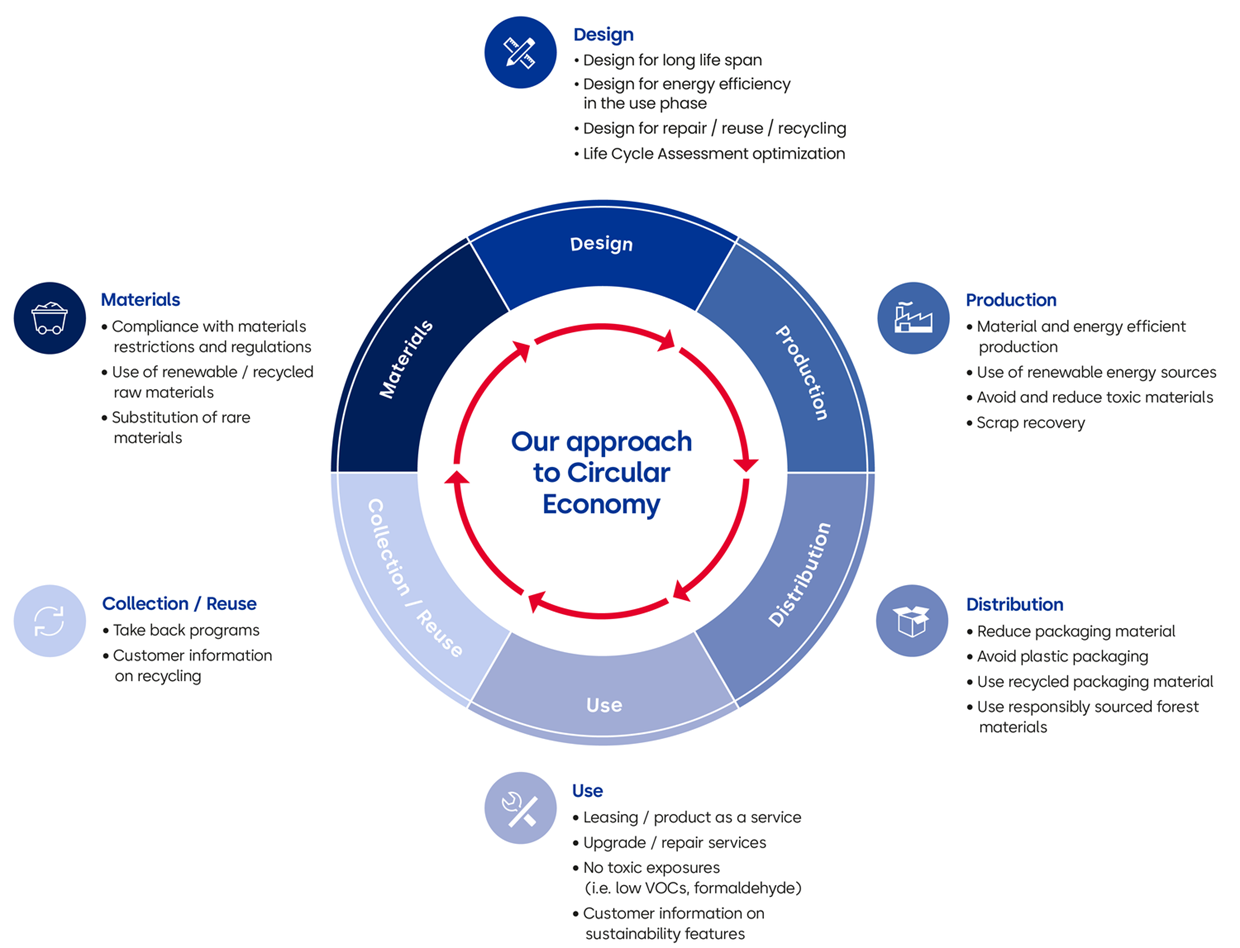
A circular approach to product design
With an average lifespan of 40–50 years, buildings should ideally be constructed in a way that allows the embedded materials and natural resources to be used efficiently. As a result, product design remains a core focus of our sustainability strategy, with an emphasis on energy consumption and carbon emissions during the product’s use phase, waste management, and recyclability at its end of life.
With the implementation of the EcoDesign Specification Template, all new product developments and optimizations follow our circularity approach, a target we achieved in FY 23/24. The template, which is part of our Adaptive Innovation Methodology (AIM) Directive, ensures sustainability criteria are met for every process related to product development across the company. It covers energy use, materials selection, longevity/durability, repairability, adaptability, and disassembly, and also sets minimum requirements for recycled content and packaging design. The template was updated in FY 25/26 to make sure sustainability criteria can be easily incorporated into the process.
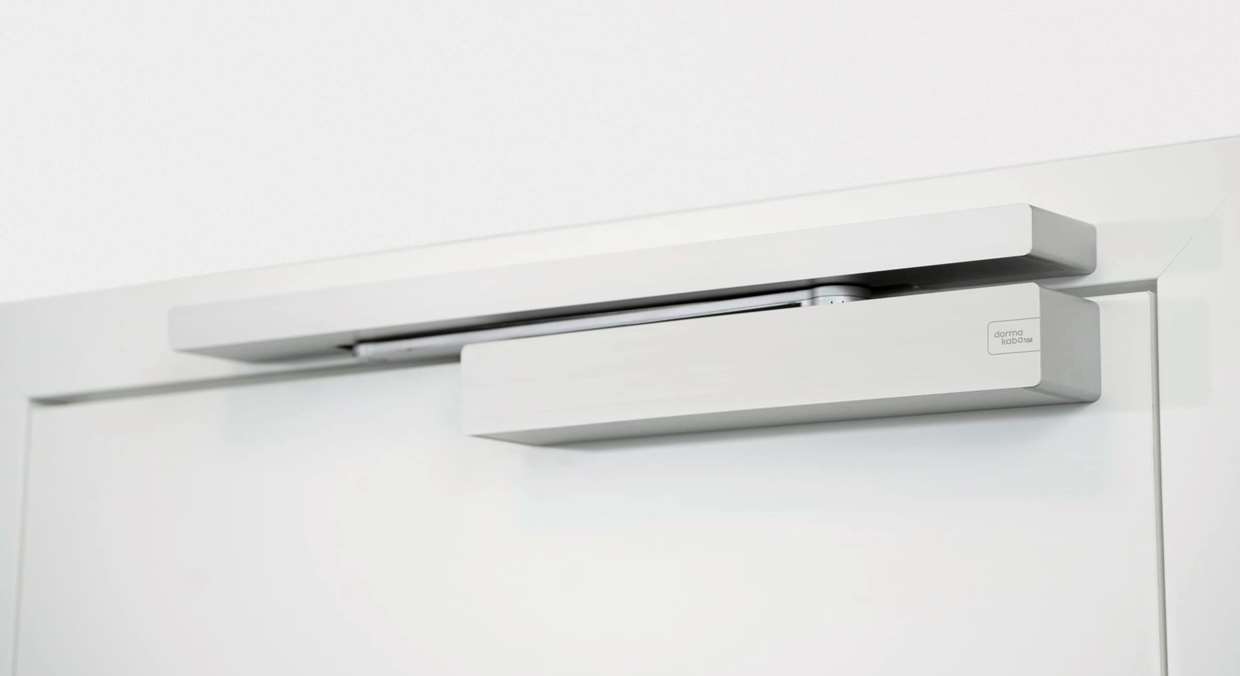
EasyAssist Pro: Turning circular design into reality
One of the first innovations to follow the EcoDesign Specification Template was the development of EasyAssist and EasyAssist Pro, a power-assisted door closer designed for use on fire-rated doors.
EasyAssist Pro helps people open heavy doors more easily while ensuring the doors close safely and in a controlled manner, supporting barrier-free building concepts and accessibility.
Instead of relying on conventional hydraulic technology, the system uses an innovative mechanical system that reuses energy generated during door operation. This removes the need for hydraulic oil, which helps avoid fluid leakage, improves fire resistance, and lowers maintenance requirements over the product’s lifetime.
Recycled content is used in its key materials such as aluminum, steel, and zinc, as well as in its packaging. The product also avoids the use of lead in metal alloys, contributing to more environmentally friendly buildings and to safer end-of-life recycling.
By applying the EcoDesign Specification Template, EasyAssist Pro became a great example of how dormakaba’s circularity approach can translate sustainability principles into practical, innovative product solutions.
Resource inflows
Materials
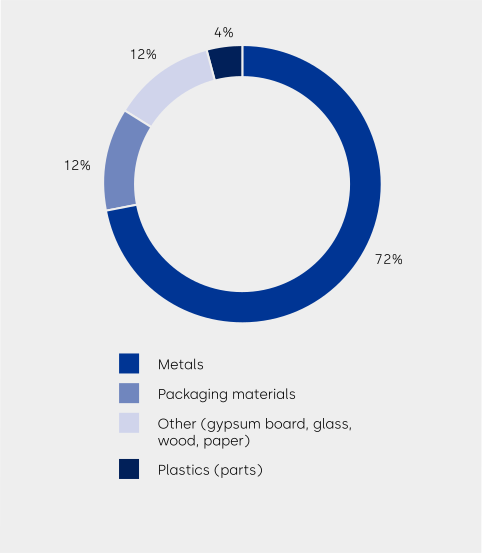
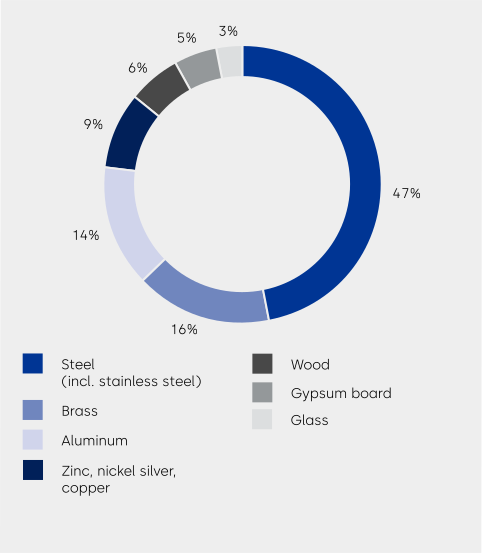
Among the most important raw materials used in our products are metals such as steel, brass, aluminum, nickel silver, and zinc for Door Hardware and Mechanical Key Systems. In addition, Entrance Systems use glass and our Movable Walls use glass and gypsum board. Wood, paper, cardboard and plastic are used in packaging.
Material use (in %)
Raw material use (in %)
We respect the universal human right to safe and clean drinking water and sanitation. As part of our obligation to respect this right, we assess the level of water scarcity in areas where we operate. The latest analysis revealed that approximately 44% of our sites have the potential for high to extreme water stress. The water stress analysis is based on the two databases Aqueduct Water Risk Atlas by the World Resources Institute and AQUASTAT by the Food and Agriculture Organization. KPIs on water withdrawals, consumption, and discharge can be found in our ESG Performance Table.
Recycled content
For more information about product declarations and certifications, see our marketing and labeling activities
As mentioned, our Environment Directive sets a minimum amount of recycled content for several materials. We also work with suppliers to help us obtain certifications on the recycled content of our products, as these help our customers achieve green building standards. The average recycled content by product group is 59% for Door Closers, 41% for Locks, 45% for Exit Devices, 46% for Sliding Doors, and 66% for Interior Glass Systems.
We were also one of the first companies to pilot the new Recycled Content Declarations (RCDs) developed by the Institut Bauen und Umwelt (IBU). The RCDs will initially be available for three pilot products, including the EasyAssist Pro, strengthening transparency and supporting our customers' circular economy ambitions. Similar to our previous recycled content certifications, the IBU’s RCDs are verified manufacturer declarations that transparently documents the exact proportion of pre-consumer and post-consumer recycled materials in construction products, in accordance with ISO 14021.
Transparency on substances of concern
To comply with the increasing regulatory requirements and to deliver enhanced transparency on material composition, we have initiated the PURE (Preparing Us for Regulatory Evolution) Materials Program. This program focuses on assessing and gradually phasing out lead-containing metals in light of recent developments under the EU RoHS (Restriction of Hazardous Substances) Directive.
A key advantage of the PURE Materials Program is its coordinated and structured methodology. This integrated approach creates synergies, improves efficiency, reduces administrative complexity, and generates cost savings while accelerating implementation efforts.
As regulatory requirements continue to evolve, dormakaba plans to expand the program’s scope to additional critical substances, including PFAS and other materials of concern. By taking action early, we aim to reduce future compliance risks and strengthen responsible material management across our products and supply chain.
In addition, and building on our long-standing collaboration with Assent in the Americas region, where we have established an automated compliance and supplier engagement process, we have continued to expand and strengthen this approach across our operations. Following its successful introduction in Germany in the previous reporting year, we further extended the system to Switzerland. This system enables structured data collection on material composition and supports proactive supplier engagement to assess the presence of any substances of concern.
And as part of our EPDs, we conduct material compliance risk assessments for all new or renewed EPDs. These identify substances of concern based on material types and, when available, are supported by supplier documentation. This step strengthens the overall robustness of our EPD process and ensures that potential chemical risks are considered early in the product life cycle.
These activities reflect our commitment to regulatory compliance, product safety, and increased material transparency across our global supply chain.
Environmentally friendly packaging
We primarily use paper, cardboard, wood, and plastic for packaging, and for each of these material types we have set targets to move towards more sustainable choices.
For example, by 2027 we want to introduce recycled plastic in our packaging, progressively increasing its share as part of the transition from fossil fuel-based plastics. This target replaces our previous goal of eliminating fossil fuel-based plastic from packaging entirely, due to material availability constraints and supplier immaturity. In FY 25/26, we started to switch plastic packaging such as screw bags and films to 50% recycled content. We managed to switch 7% of our spend in these categories accordingly.
We have also set a target to source 100% of paper, wood, and carton from responsible forestry certification schemes that are accepted by the US Green Building Council, like the Sustainable Forestry Initiative (SFI), American Tree Farm System (ATFS), and Program for the Endorsement of Forest Certification (PEFC). To support this, we work with suppliers to encourage certification under responsible forestry schemes, organizing meetings with third-party representatives to raise awareness and address certification questions. By the end of FY 25/26 we had transitioned around 30% of our paper packaging, over 59% of our cardboard, and 65% of wood packaging.
Resource outflows
Products
We manufacture Access Automation Solutions (door operators, sliding and revolving doors), Access Control Solutions (connected devices and engineered solutions), Access Hardware Solutions (door closers, exit devices, mechanical key systems), Key Systems (key blanks, key cutting machines, and automotive solutions) and Movable Walls (acoustic partitions and partitioning systems).
Repairability
We prioritize the repairability and adaptability of our products, ensuring they can be easily upgraded to meet new technological standards. This approach contributes to maximizing the reference service life of our products while also enabling simple disassembly at the end of their life cycle. To achieve this, we incorporate key design principles such as modular concepts, the use of standardized components, and ensuring upgradability and backward compatibility. Additionally, we focus on using detachable connections, reusable fasteners, and avoiding adhesive bonds or metallic continuity, all of which enhance the overall serviceability of our products. Through these measures, we aim to ensure that all our products remain fully serviceable throughout their life cycle.
Additionally, as part of our efforts to improve repairability, we created initial demounting instructions for selected products. These instructions are designed to support service technicians and users in identifying and replacing individual components, thereby extending product lifespan and reducing waste.
Durability
To ensure long-term user satisfaction, our products are designed to surpass the standard reference service life, as defined by applicable ISO/EN norms. We implement several strategies to extend this lifespan, including analyzing and reinforcing weak points from previous product versions, allowing for the disassembly of key parts for maintenance or repair without damage, and ensuring the availability of replacement parts. Additionally, we offer extended warranties and provide information to help consumers maintain and extend the product’s life, including guidance on necessary inspection and maintenance intervals.
Expected durability
|
Product type |
|
dormakaba products |
|
Automatic and Manual Sliding Doors |
|
1,125,000 cycles |
|
Card Readers & Peripherals |
|
13.9 years |
|
Door Closers |
|
740,000 cycles |
|
Electrified Door Hardware |
|
20 years |
|
Electronic Hotel Locks |
|
10 years |
|
Electronic Locks, Cylinders, Keys and Cores |
|
10.9 years |
|
Emergency Exit Systems |
|
350,000 cycles |
|
Glass Hardware |
|
21.1 years |
|
Lever handles |
|
200,000 cycles |
|
Mechanical Locks, Cylinders, Keys and Cores |
|
370,000 cycles |
|
Movable Partitions |
|
62.5 years |
|
Revolving Doors and Interlocks |
|
1,450,000 cycles |
|
Safe Locks |
|
7 years |
|
Sensor Barriers/Speed Gates |
|
16.3 years |
|
Sliding Door Operators |
|
940,000 cycles |
|
Swing Door Operators |
|
10 years |
|
Terminals |
|
10 years |
|
Turnstiles |
|
15 years |
Recyclability
By focusing on design for disassembly and using recyclable components, we enable our customers — as well as any companies responsible for building demolition or renovation — to properly recycle our products at the end of their life cycle. Recyclability rates are available in all of our EPDs. A summary of recyclability rates averaged across product families is found below.
|
Product family |
|
Average recyclability rates (excl. packaging) in % |
|
Automatic and Manual Sliding Doors |
|
63 |
|
Card Readers & Peripherals |
|
48 |
|
Door Closers |
|
97 |
|
Electrified Door Hardware |
|
90 |
|
Electronic Hotel Locks |
|
95 |
|
Electronic Locks, Cylinders, Keys and Cores |
|
91 |
|
Emergency Exit Systems |
|
94 |
|
Glass Hardware |
|
97 |
|
Lever handles |
|
95 |
|
Mechanical Locks, Cylinders, Keys and Cores |
|
96 |
|
Movable Partitions |
|
29 |
|
Revolving Doors and Interlocks |
|
50 |
|
Safe Locks |
|
63 |
|
Sensor Barriers/Speed Gates |
|
72 |
|
Sliding Door Operators |
|
90 |
|
Swing Door Operators |
|
65 |
|
Terminals |
|
47 |
|
Turnstiles |
|
63 |
Waste management
We aim to send zero waste to landfill in our operations by 2027 (baseline 3,443 tons in FY 20/21) in order to decrease our disposal rate. To reach this, 33 manufacturing sites are developing sustainable waste management roadmaps. Some of the sites with the largest potential impact receive tailored support in collaboration with external experts from Beyondly, including waste assessments, waste flow mapping, site audits, detailed waste composition analyses, and waste optimization plans. During FY 25/26, we completed engagement in Russia, Peru, and two plants in Canada, bringing the total number of sites receiving tailored support through the program to ten.
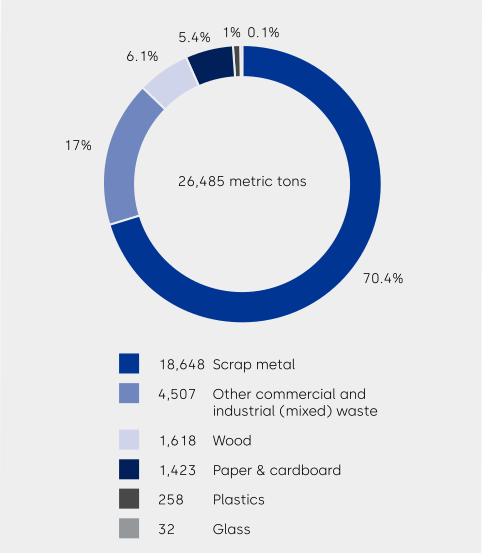
We monitor our waste by treatment method and waste type. At 70% by weight, the largest proportion of non-hazardous waste is scrap metal, followed by other commercial and industrial waste (17%), wood, paper, cardboard, and chemicals. In FY 25/26, approximately 89% of the waste stream was recycled, reused or recovered.
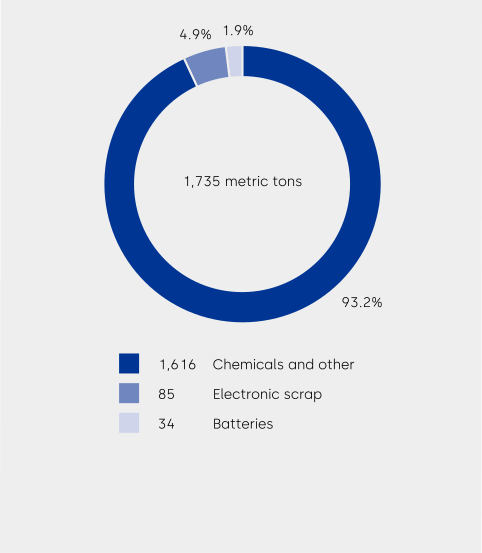
Hazardous waste management is especially crucial in electroplating, surface finishing, and painting processes. We work to minimize the volume and toxicity of waste from these operations through continuous improvement projects. Our filter systems prevent hazardous substances from being released externally, and toxic waste is disposed of as special waste. Certified disposal companies are commissioned to dispose of industrial waste and chemicals, and to recycle materials wherever possible.
Non-hazardous waste by type
(in metric tons)
Hazardous waste by type
(in metric tons)
Take-back programs
dormakaba products have typical lifetimes of 10–20 years, with some products having 40-year lifetimes. Even after these long lifetimes, some materials and components could be reused, repaired, or reintroduced as raw materials into the manufacturing cycle.
Between 2023 and 2025, we invested significant effort in piloting take-back programs across Austria, Germany, and the UK, including detailed feasibility studies, stakeholder workshops, and market assessments, but overall progress was limited. Structural barriers such as lack of control over end-of-life handling, low partner engagement, and well-established recycling streams meant that dedicated take-back systems for our products did not deliver meaningful ecological or economic benefits, despite isolated success in Germany with electromechanical components. As a result, we have been reassessing our overall approach to take-back programs. Our aim is now to continue to conduct feasibility studies to evaluate take-back schemes for selected products in key markets until 2027, in collaboration with industry associations where possible.
Beyond the feasibility assessments in the three pilot countries, we launched a feasibility study in India, where market demand is strong and our teams have greater visibility into the end-of-life stage of our products, in this case door closers and gates. We are in the early phase of collaborating with a waste-auction company to encourage customers to return end-of-life dormakaba products to certified recyclers.
In Germany, we launched another pilot program under Circular Spaces by DORMA Hüppe, aimed at finding solutions for repairing, refitting, reusing, and recycling our movable wall products. For this, we are collaborating with an external consultancy and plan to apply the concept of urban mining, leveraging their knowledge of which buildings are being renovated, gutted, or demolished. This approach gives us access to information about our built-in products and allows us to work with building owners to decide on their future use.